
Medical disclaimer: This is not healthcare advice. Just preparation of observations.
Walk into the consult already knowing the story.
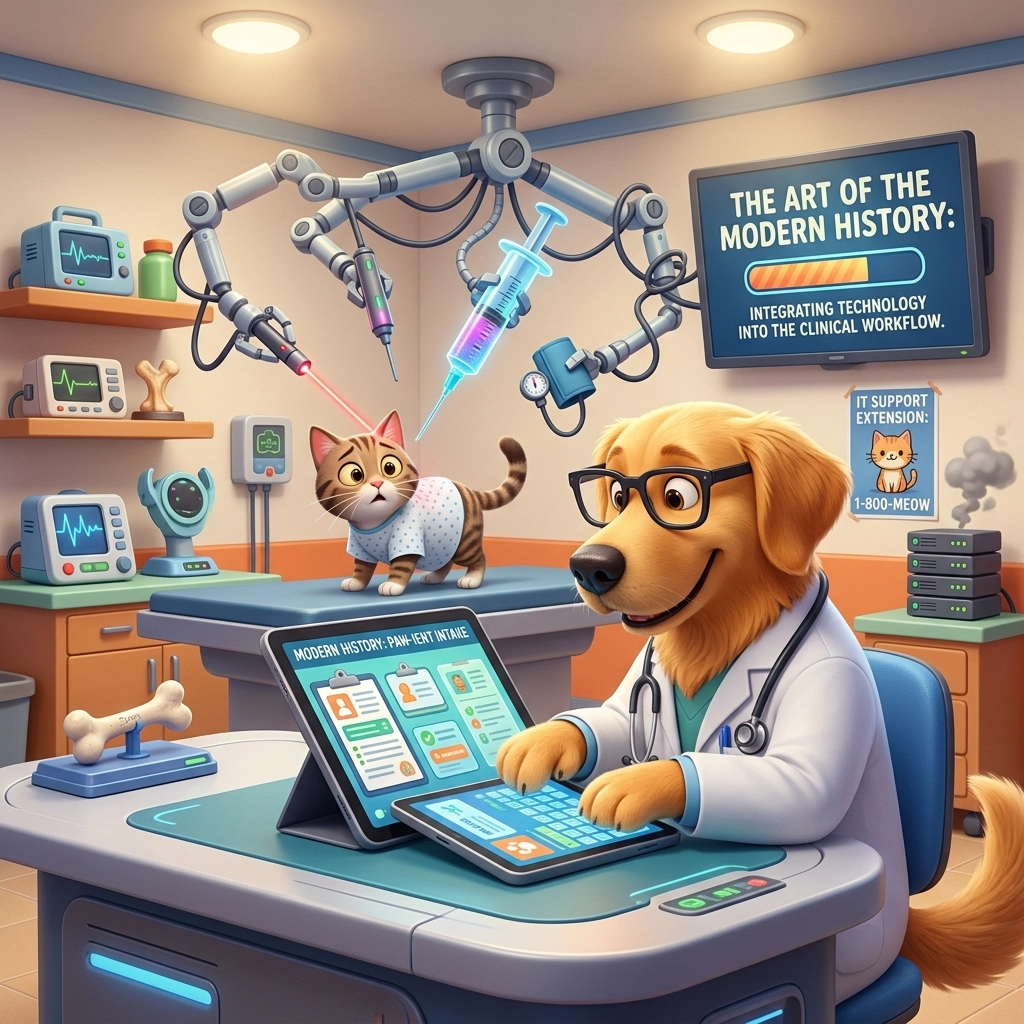
Veterinary medicine looks modern. Digital radiography. Advanced ultrasound. Sophisticated monitoring. Referral-level surgery. The tools in today’s clinic would be nearly unrecognizable to a practitioner from 50 years ago.
And yet one core part of the consult has changed far less than almost everything around it: history-taking.
In too many appointments, the clinical story still begins with a hurried conversation, a blank note field, and a client trying to remember exactly when the vomiting started, whether the limp was worse on Tuesday or Wednesday, and which medication was missed over the weekend. The contrast is hard to ignore. We use high-tech diagnostics to investigate disease, but still rely on low-tech recall to frame the case.
Introduction: The Technological Gap in the Modern Clinic
This gap matters. The history is not administrative background. It is clinical context. It shapes your differentials, your exam focus, your recommendations, and your next steps. When that context is gathered manually, under time pressure, the opening minutes of the consult are often spent reconstructing a story that could have been assembled more clearly before the patient ever entered the room.
A modern clinic deserves a modern approach to the history. Not because technology should replace conversation, but because it should prepare it. When observations are collected before the consult and organized into a structured view, the appointment starts at a higher level. You are not beginning with fragmented recall. You are beginning with readiness.
The 50-Year Stagnation: Why History-Taking Stayed Manual While the Rest of the Clinic Evolved
Why did history-taking stay stuck while diagnostics, imaging, and treatment advanced? Part of the answer is habit. History-taking has long been treated as something too personal, too conversational, or too variable to improve with structure. So the process remained anchored to spoken recall, handwritten notes, and real-time typing.
But that assumption no longer fits the reality of modern care.
Clients already document their pets’ lives constantly. They take photos of wounds, record coughing episodes, note appetite changes, and text family members about symptoms as they happen. The data exists. What has been missing is a clinical way to gather it, organize it, and review it before the consult.
When a pet parent submits a structured history through unlock.tailepet.com, the story does not arrive as a scattered memory exercise. It arrives as usable context. Symptoms can be ordered chronologically. Notes can be attached to dates. Media can be reviewed in sequence. Instead of relying on what is remembered in the room, you can start with what was documented closer to the event.

That is the overdue upgrade. Not removing the human element. Improving the quality of the clinical starting point.
The Modern History Kit: Beyond the Notepad to Dashboards and Visual Progression
The modern history kit replaces improvisation with structure. It does not eliminate discussion. It makes the discussion better.
Instead of starting with a blank screen and a stream of fragmented recall, you begin with:
- Structured timelines that show when symptoms started and how they progressed.
- Dashboards that organize observations into a clinically readable view.
- Photo and video uploads that capture events as they actually happened.
- Visual progression that reveals change over time, not just a single moment.

This changes the shape of the consult. A dermatology case is no longer limited to what the skin looks like in the room today. A recovery case is no longer summarized by “he seems a bit better.” A chronic issue is no longer reduced to vague memory. You can review the progression. You can compare media points. You can see the timeline.
By encouraging pet owners to upload photos, videos, and notes into a structured dashboard, you turn everyday observation into clinical preparation. A 3:00 AM coughing video matters. A before-and-after wound sequence matters. A symptom log tied to medication timing matters. These details become easier to interpret when they are organized before the appointment starts.

This is what history-taking looks like when it catches up to the rest of the clinic: cleaner inputs, sharper context, and a much stronger starting position for decision-making.
Precision Readiness: How a Tech-Upgraded History Matches the Quality of Modern Diagnostics
Modern diagnostics are built on precision. The history should be too.
When your imaging is advanced, your monitoring is detailed, and your treatment plans are increasingly sophisticated, it makes sense for your intake process to meet the same standard. A tech-upgraded history supports precision readiness. It gives you organized context before the exam. It helps you identify patterns faster. It allows you to spend less time extracting basic facts and more time applying clinical judgment.
This approach improves the consult in practical ways:
- It aligns the history with the standard of modern diagnostics.
- It sharpens the quality of the information available at the start of the visit.
- It gives visual evidence a clear place in the record.
- It helps the consult begin with interpretation rather than reconstruction.
The transition is low-friction. It starts with a shift in mindset: the history is not a manual ritual that must stay frozen in time. It is a clinical input, and clinical inputs can be upgraded.
As one practitioner recently shared: "I used to feel like I was always playing catch-up. Now, I walk into every room with a plan. The clients notice the difference. They feel like I’m really listening to them, even though I’m actually doing less 'asking' than I used to. The data is already there."
Conclusion: Working Smarter, Together
The long-overdue upgrade is not about adding technology for its own sake. It is about bringing one of the most important clinical inputs in the consult up to the standard of the rest of modern veterinary medicine.
When the history is structured before the appointment, the room feels different. You walk in prepared. You have the timeline. You have the media. You have the progression. And you can focus your attention where it belongs—on clinical reasoning, clear communication, and patient care.
We invite you to explore a new way of working. One where the history is no longer the least modern part of a highly modern clinic. By integrating structured pre-consult history collection into your workflow, you are upgrading the quality of the consult from the very first minute.
Visit unlock.tailepet.com to see how dashboards, timelines, and visual histories can help your team walk into the consult already knowing the story.
Frequently Asked Questions
Does this replace my current PMS?
No. It is designed to complement your current workflow by providing a structured intake of information that can be easily referenced or integrated into your existing records.
Will pet owners actually use it?
Yes. Most pet owners prefer to provide information in a quiet environment where they can review their pet’s history, add photos or notes, and be more accurate. It gives the clinic better context before the appointment begins.
How much time does this really save?
On average, practitioners save 5–8 minutes per consult by having the history pre-structured. Over a full day of appointments, that creates more room for focused examination, clinical decision-making, and clearer communication.
Is it difficult to set up?
Our goal is professional liberation, not more work. The setup is designed to be intuitive and low-friction, fitting into your clinic's existing habits from day one.
Leave a Reply