
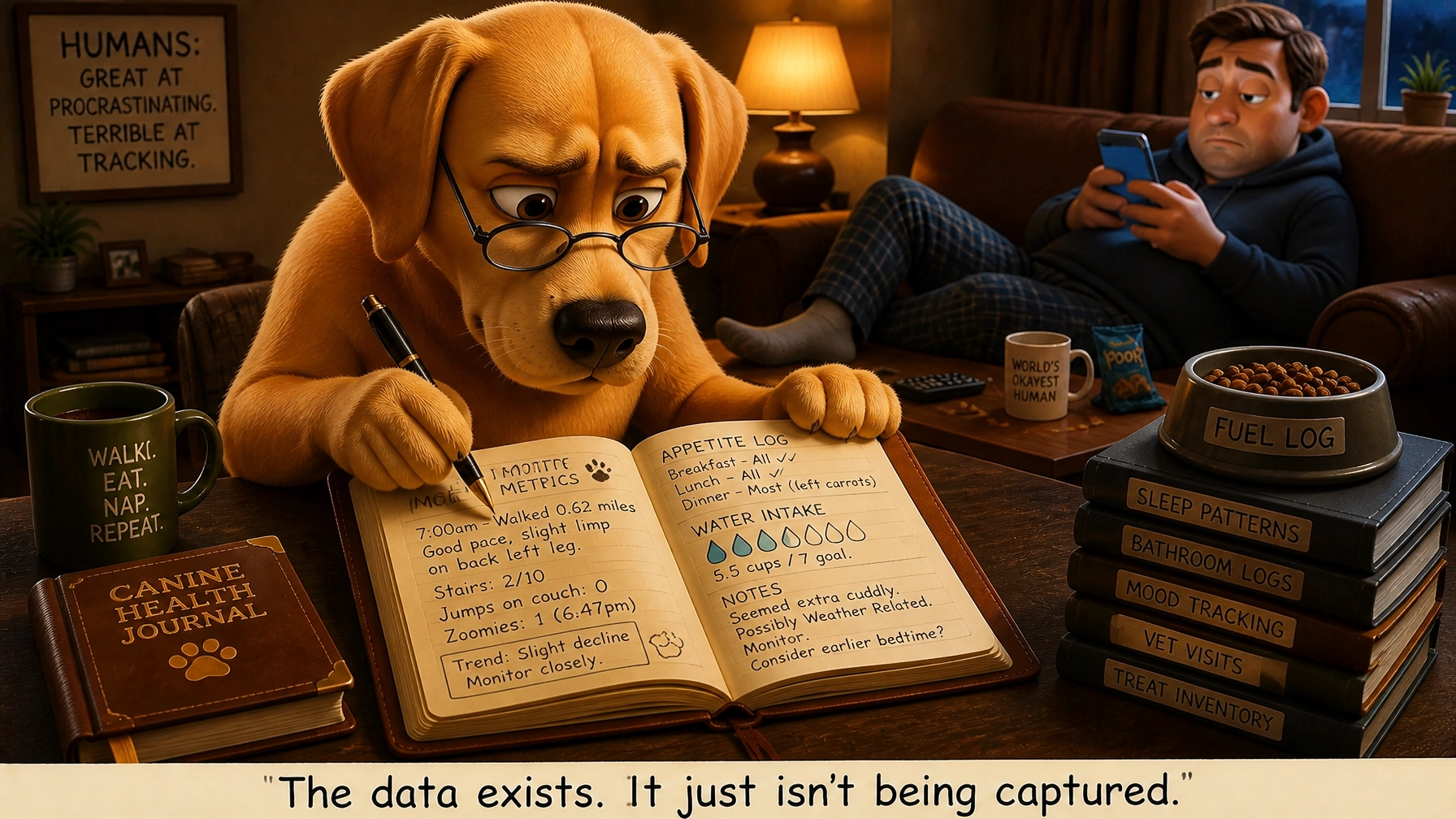
A standard veterinary consult is a short, high-pressure snapshot. You examine the patient. You palpate the abdomen. You check the heart rate. You watch the gait across a sterile floor.
But the patient does not live in your exam room. The useful clinical story—the change in thirst, the pattern of cough, the slow decline in mobility—happens between visits.
When the patient arrives, you are asking the owner to summarize that time from memory. That is the design flaw. Clinical decisions are being built on incomplete, biased, and often inaccurate recall.
This is not a client failure. It is a workflow problem.
Every missing detail has to be rebuilt in real time. Every vague answer has to be translated into something usable. Every wandering story has to be sorted into signal and noise while the clock keeps moving. In many clinics, the start of the consult is not clinical reasoning. It is memory recovery.
That leaves you carrying the burden of missing information while still being expected to make precise decisions.
The Design Problem of the 15-Minute Consult
The current consult model assumes that an owner can accurately report clinical trends under pressure. That assumption does not hold up.
Picture the exam room. The dog is pacing. The cat is vocalizing in the carrier. The owner is worried about the pet, the bill, and the rest of their day. Then you ask, "How many times did he vomit last week?" or "When exactly did the lethargy start?"
Memory is not a recording. It is a filter. Under stress, recall gets worse. "A few days" may mean two weeks. "Once or twice" may mean daily. That is not dishonesty. It is normal human recall.
When you depend on that recall, the first part of the visit is spent building a baseline that should already exist. You are listening, typing, clarifying, redirecting, and building a timeline all at once. That is where the cognitive drag shows up.

Recall Bias: The Structurally Unreliable Foundation
Incomplete data leads to cognitive bias. When the history is noisy, the clinician’s brain seeks shortcuts.
You might anchor on the first symptom the owner mentions. You might rely on availability bias—diagnosing based on the last similar case you saw rather than the data in front of you. These are not failures of skill. They are predictable responses to a lack of structured information.
That is why chronic disease management makes the gap obvious. What happens between visits matters more than what you see in the room.
Osteoarthritis: Decline Happens Quietly
Osteoarthritis usually shows up as small adjustments to daily life. A dog hesitates before jumping into the car. A patient stops using the stairs. A pet that used to greet the family at the door now stays on the bed longer. Owners may call it aging and never mention it unless you ask the exact right question.
That creates a major data gap. In the consult room, gait can look acceptable on a smooth floor over a few seconds. At home, on hardwood, stairs, couches, and cold mornings, the story can be very different.
CKD: The Trend Is the Case
With chronic kidney disease, subtle home observations are often the earliest warning signs. Water intake creeps up. Appetite becomes selective. Nausea appears as lip licking, food aversion, or walking away from meals. Urination patterns shift.
Owners rarely report these trends accurately on the spot. The difference between "drinking more lately" and a clear pattern of increased intake with reduced appetite is clinically meaningful. One is an impression. The other is usable context.
CKD management depends on longitudinal context. Without it, every recheck starts with reconstruction. You are trying to decide whether this is stability, gradual decline, a medication issue, or a problem that needs action now.
Without structured home observations, you are guessing. You might order extra tests to compensate for the data gap. Or worse, you might miss a subtle decline until it becomes a crisis.
The solution is not to ask more questions during the consult. The solution is to change when and how the information is collected.
Inter-Consult Observations: Capturing the 10,000 Minutes
To fix the design flaw, history-taking has to move out of the exam room.
When an owner can log a symptom or observation on their phone before the visit, the information is captured closer to when it happened. It is more structured. It is easier to review.

Reclaiming the Clinical Day
Clinic efficiency is not about moving faster. It is about removing low-value work.
Moving history-taking upstream reduces friction at the start of the consult. The bigger gain is cognitive. You spend less energy on preventable ambiguity and start with usable context.
When you walk into a consult, you already have the history. You have reviewed the structured dashboard. You know when the cough started. You have seen the photo of the vomit. You do not start with "What's happening?" You start with the next step.
From Interrogation to Collaboration
The best veterinarians are often the most talkative. They prioritize rapport. They build trust.
The traditional history-taking model forces these vets to choose between clinical accuracy and client connection. If they spend time bonding, they run behind. If they focus on data, they can seem cold.
Structured pre-consult data removes that conflict. The consult moves from interrogation to collaboration. You are not digging for facts. You are interpreting them with the owner. That shifts time toward clinical decisions and rapport instead of repetitive data entry.

See what a pre-consult dashboard looks like at unlock.tailepet.com.
Leave a Reply