
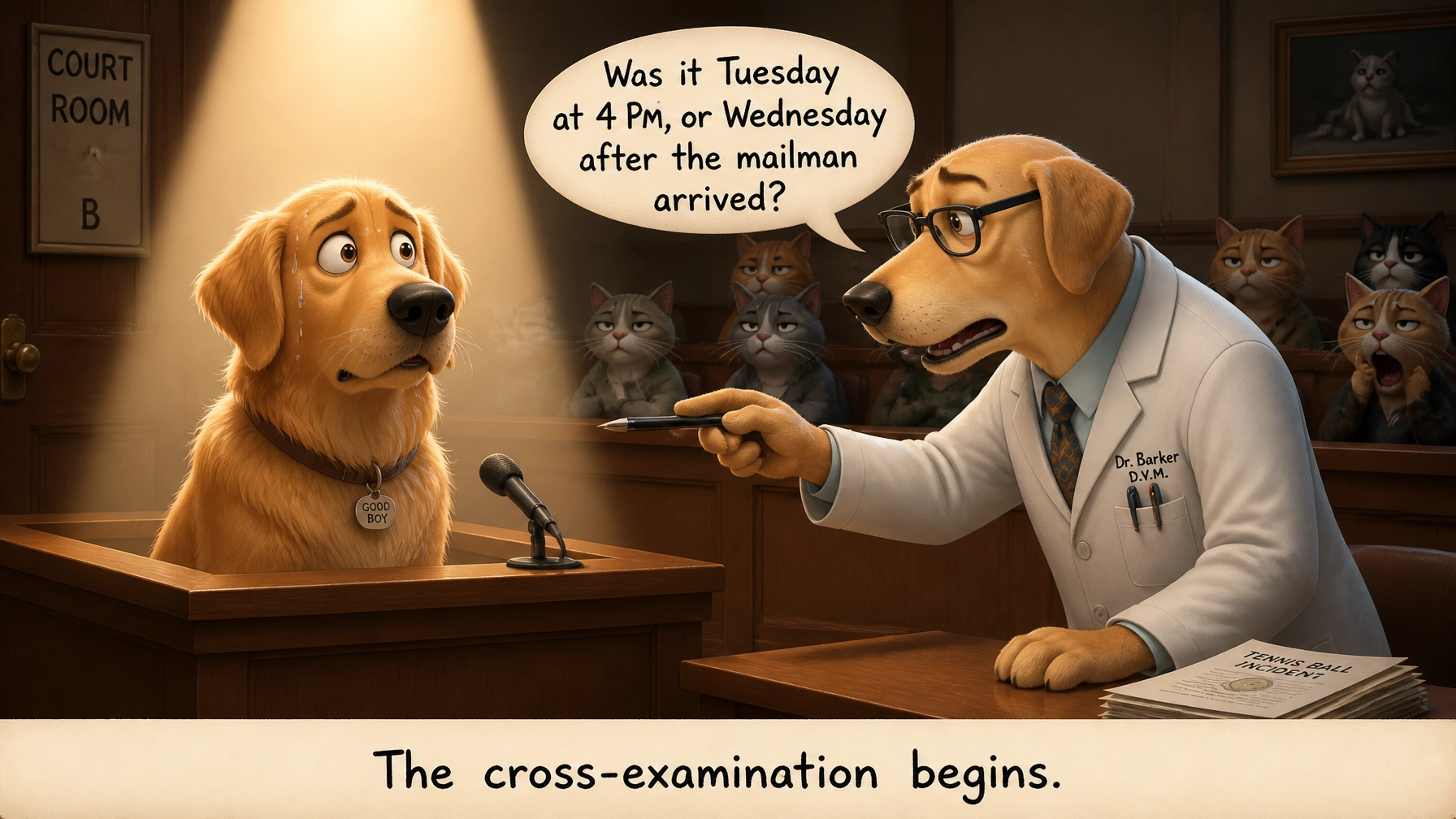
"How long has he been limping?"
You wait. The owner stares at the ceiling. They look at their partner. The partner looks at the dog.
"Maybe three days?"
"No, it started after we went to the park on Saturday."
"Was that Saturday or Friday?"
This is the standard opening act of a veterinary consult. It is a polite interrogation. You are the detective, and the witness is unreliable.
The problem isn't that clients lie: though some do. The problem is that human memory is not a hard drive. It is a reconstructive process. Under the fluorescent lights of an exam room, with a nervous pet and a ticking clock, memory fails.
Memory is not a medical record. Relying on it as your primary diagnostic tool is a risk to your clinical outcomes and your sanity.
The Three Failures of Recall
Clinical history is the foundation of every diagnosis. Research suggests that in human medicine, doctors can reach the correct diagnosis up to 76% of the time based on history alone. In veterinary medicine, that number is likely lower because our patients don't talk: and their representatives are stressed.
When you rely on in-room recall, you face three systematic failures:
1. The Dating Error
Owners struggle with timelines. "A few days" is the most common unit of measurement in vet med, but its definition is fluid. It can mean 48 hours. it can mean two weeks. Without an anchor: like a holiday or a specific event: owners guess. Guesswork leads to inaccurate staging of chronic conditions like OA or CKD.
2. The Omission of the "Unimportant"
Owners filter information. They tell you about the vomiting because that's why they are here. They don't tell you about the increased water intake or the subtle change in gait because they don't think it's related. If you don't ask the right question, that data is lost.
3. The Category Error
"Is he on any medications?"
"No."
Later, you find out the dog gets aspirin every morning and a "natural supplement" for his joints. To the owner, these aren't "medications." They are just things they give him. These omissions aren't just annoying: they are dangerous.

Caption: "I don't recall any 'unauthorized treats,' only a very suspicious-looking piece of cheese that fell on the floor."
The 7-Minute Interrogation Tax
We’ve talked before about the 7-minute tax. This is the time spent extracting these shaky memories.
When you spend seven minutes cross-examining an owner to find out if the scratching started before or after the new food arrived, you are burning clinical capacity. You are also burning your own energy.
By the time you get the "real" history, you have five minutes left for the physical exam and the actual clinical decision. You are rushed. The owner feels the rush. The pet feels the stress.
This is where the 10,000 minutes gap begins.
Moving History to the Living Room
The solution isn't to be a better interrogator. The solution is to change where the interrogation happens.
Data is more accurate when it is collected in the environment where the behavior occurs. When a pet parent is sitting on their couch, they can check the calendar. They can look at the medication bottle. They can see the half-eaten bag of treats.
This is why we built taile.

Instead of the 7-minute dance, the owner completes a 30-second survey on their phone before they even leave their house. They upload photos of the rash. They note the exact date the coughing started.
By the time you walk into the room, the data is already organized. You aren't asking "when?" You are saying, "I see this has been going on since Thursday."
The Talkative Vet’s Secret Weapon
There is a myth that automated history-taking makes consults feel "cold" or "robotic."
The opposite is true.
The best veterinarians are talkative. They are rapport-builders. They want to know about the dog’s personality and the owner’s weekend. But you can't build rapport when you are frantically typing "V/D x 3 days" into your PIMS while the owner talks.
When you unlock the history before the consult, you redeploy those 7 minutes. You use them for meaningful clinical discussion. You use them to explain the "why" behind your treatment plan.
You shift from data collector to clinical advisor.

Accuracy Through Structure
Standardization is the enemy of error.
When you rely on memory, you rely on the owner's interpretation of "normal." When you use a structured dashboard, you get objective metrics. You see the trend in medication compliance. You see the frequency of symptoms.
This structure bypasses the reception desk confusion. It prevents the "he seems fine" shrug. It gives you a clear clinical picture that survives the transition from the waiting room to the exam table.
How to Reclaim Your Day
You don't need a complex integration. You don't need a credit card. You just need five minutes to set up your dashboard.
- Direct-to-Parent History: Send the link. Let them do the work.
- Instant Review: Scan the structured data in seconds.
- Clinical Focus: Spend your consult making decisions, not digging for dates.
The result is a 29% increase in capacity. That is 23 more consult slots per week or 5.5 hours reclaimed.
Stop playing detective with a witness who can't remember what they had for breakfast.

Caption: "I already knew about the sock, Buster. Let's talk about the recovery plan."
Frequently Asked Questions
Will clients actually do this?
Yes. We see a 64% completion rate. Owners love sharing photos and details about their pets. They would rather type it out at home than repeat it three times to the receptionist, the tech, and finally the vet.
Does it work with my PIMS?
Yes. taile is designed to be compatible with any Practice Management System. It works alongside your current workflow, not against it.
How much time does it really save?
The average manual history takes 7 minutes. A taile review takes under 30 seconds. You reclaim nearly 6.5 minutes per consult.
Is it hard to set up?
It takes under 5 minutes. No IT degree required. No credit card required to start.
Unlock your clinic’s potential. Move the history from the owner's memory to your dashboard.
Visit unlock.tailepet.com to start today.
Leave a Reply