
Date: Thursday, June 4th, 2026
Category: insights
It’s Friday. 4:45 PM.
You’ve finished the workup. Now comes the discharge sprint.
You explain the meds. The warning signs. The dosing schedule. The weekend plan. The client nods. You hope it lands.
Then you walk back to your computer with that familiar pit in your stomach.
Did they get it?
Did I miss something?
Is this going to become a Sunday emergency call?
That feeling is what happens when we focus only on the consult and ignore the gap around it.
And when clinics ignore the 7-Minute Tax of manual history-taking, the 15-minute consult stops being just inefficient. It becomes a health and safety risk.
Because the real number isn’t 15 minutes. It’s 10,080.
That’s the number of minutes in a week.
You might spend 20 of them face-to-face with a patient. The other 10,060 happen between consults — at home, after discharge, over the weekend, and in the moments when clients are trying to remember what you said.
That’s where confusion starts. That’s where compliance slips. That’s where anxiety grows.
And that’s why Inter-consult Intelligence matters.
Dr. Anthony Zambelli captured the goal perfectly: an “easy conscience before the weekend.”
That isn’t a nice extra. It’s the standard.
If you leave on Friday wondering whether the owner understood the insulin instructions, the consult isn’t really over. It’s just unfinished.
The problem isn’t talking
Talkative vets are often the best vets.
They build rapport. They explain the why. They connect. They earn trust.
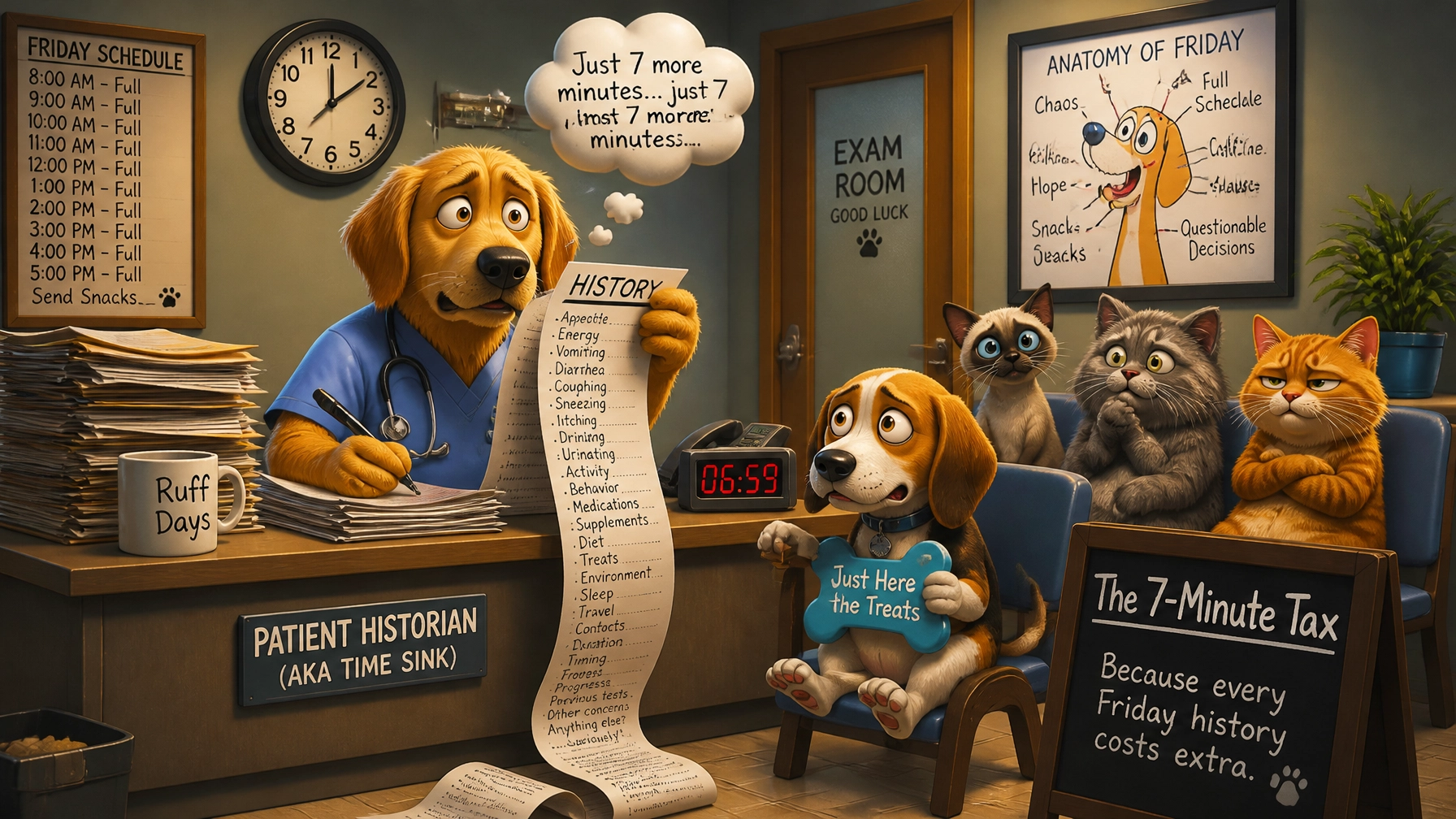
The problem is not conversation. The problem is the 7-Minute Tax: manual history-taking done in the room, over and over, before the real consult even starts.
When the first half of the consult is spent asking what happened, when it started, and whether the cough changed, you lose the time needed for judgment, clarity, and connection.
That cost adds up fast. Cut those 7 minutes of manual history-taking and a clinic can unlock 23 extra consult slots per week, create 29% more capacity, and reclaim 5.5 hours weekly.
You also increase risk when history stays scattered. Missing context leads to missed patterns, rushed decisions, weaker discharge communication, and preventable clinical errors. It pushes vets to work in a constant state of catch-up — and that is exactly how burnout compounds.
That’s the trap.
Enter: Inter-consult Intelligence
Inter-consult Intelligence means the history is structured before the appointment starts.
That changes everything.
Instead of using precious consult minutes to gather scattered details, you walk in prepared. You already have the timeline. The notes. The photos. The pattern.
That lets you:
- Unlock better consults — less backtracking, more decision-making
- Reclaim connection — more time to explain, reassure, and bond
- Redeploy 5.5 hours weekly — away from repetitive intake and toward medicine
- Open 23 extra consult slots — without extending the day
- Create 29% more capacity — by cutting the 7-minute drag before care even starts
This is not about making vets talk less.
It’s about making sure the time you spend talking actually counts.
The gap between consults is the opportunity
The 10,080-minute week is happening whether your clinic captures it or not.
The question is simple: are you walking into the room blind, or walking in with context?
Ignoring the 7-Minute Tax forces clinicians to make decisions with partial information. That is bad for workflow, bad for wellbeing, and bad for patient safety.
When pre-consult history is structured in advance, the exam room shifts.
Less stenography.
More medicine.
Less scrambling.
More clarity.
Less Friday anxiety — more easy conscience before the weekend.
Want to take a look?
Visit unlock.tailepet.com if you want to see how pre-consult history can help you walk into the room prepared.
Leave a Reply