Date: Tuesday, June 2nd, 2026
Category: insights
Walk into a human cardiologist’s office today. What’s the first thing that happens? You’re handed a clipboard: or more likely, a tablet: and asked to fill out four pages of history. You document your medications, your family history, your lifestyle, and that weird palpitation you had three weeks ago.
By the time the specialist walks into the room, they aren't asking you "So, what brings you in?" They are looking at a structured data set. They are already analyzing. They are already being a doctor.
Now, walk into a veterinary clinic.
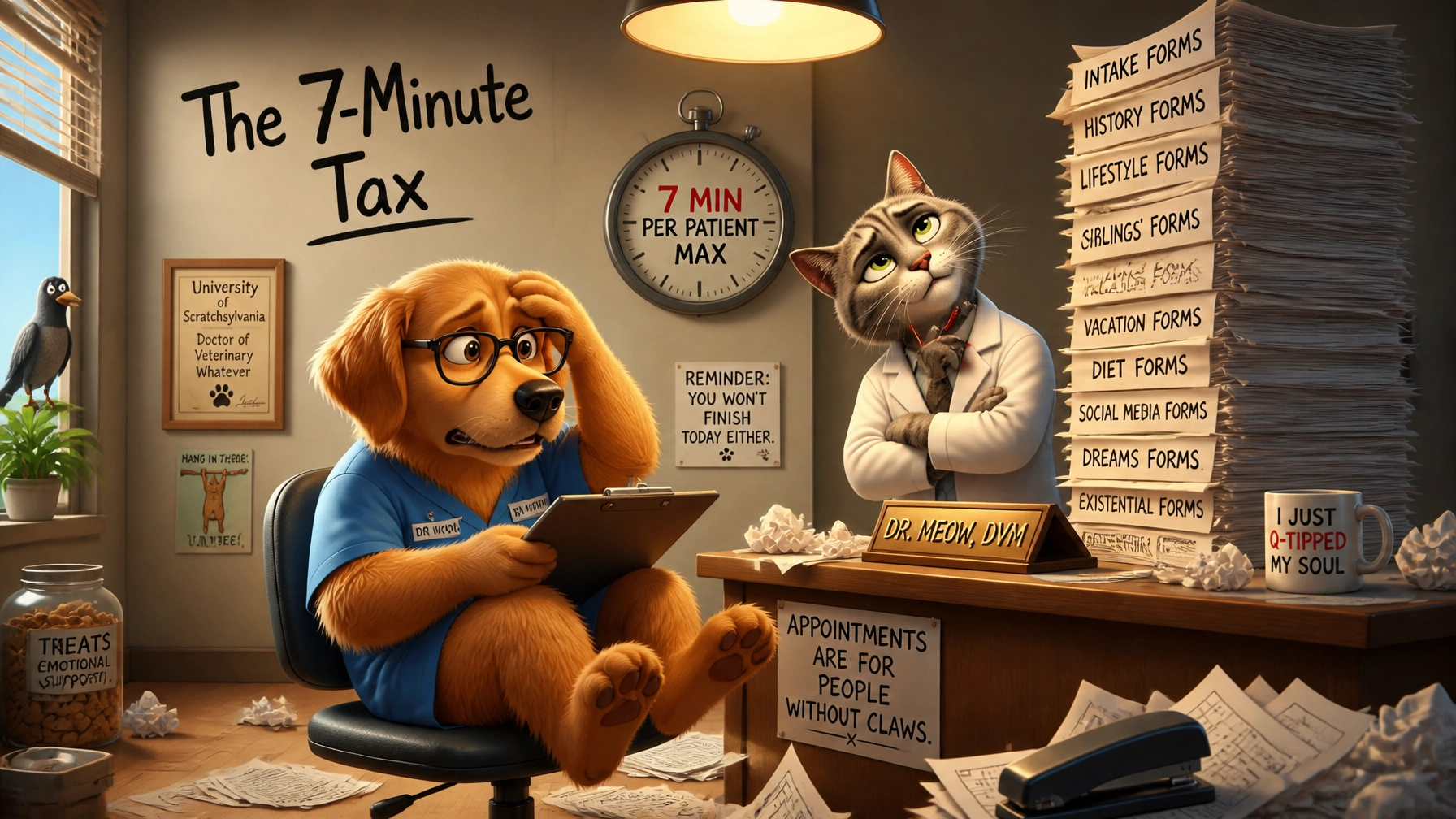
The vet walks in, greets the client, and then pays the 7-Minute Tax of manual history-taking. In a fifteen-minute consult, that means nearly half the slot is gone before the exam really starts. While the owner recounts a rambling story about what the dog ate at a barbecue last Tuesday, the vet is typing. Head down. Back to the patient. Fingers flying across a keyboard.
Vets are the only medical professionals who still do their own data entry. It’s time we asked: Why are we okay with this?
The Invisible Cost of the 7-Minute Tax
Let’s be blunt: you didn't go to vet school for six years to practice your typing speed. You went to school to be a medical detective, a surgeon, and a healer. Yet, in the current "Standard Consult" model, a massive chunk of your billing hour is spent paying the 7-Minute Tax: manual history-taking.
When you do the "admin" work for the owner, you aren't just losing time; you’re losing the clinical logic that prevents burnout. Every minute you spend asking "When did the vomiting start?" is a minute you aren't spending examining the abdomen or explaining the treatment plan.
And the math is not subtle. Cut that 7-minute tax and a clinic can unlock 23 extra consult slots, reclaim 5.5 hours weekly, and create 29% more capacity without adding another doctor.

Visual Suggestion: A "Time-Value Pie Chart" comparing a Standard Consult (40% Data Collection/Admin) vs. a Modern Consult (90% Clinical Logic/Surgery).
In a standard consult, nearly half of the appointment cost is essentially "Data Collection." This is low-value work. In a modern, taile-powered consult, the owner provides that data in advance. Suddenly, 90% of the consult is "Clinical Logic." That’s high-value work. That’s why clients pay the big bucks.
Efficiency is a Myth: Accountability is the Cure
We’ve been talking about "efficiency" in vet med for a decade. We’ve tried shorter appointments, scribes, and voice-to-text. But the real issue is Accountability.
The most sensitive nerve in our profession is the relationship between the "Expert" (you) and the "Caregiver" (the owner). For too long, we’ve allowed a culture where the vet is the sole detective in the room. We take on the entire burden of the diagnostic journey, while the owner remains a passive observer.
Here is the controversy: An owner who refuses to spend five minutes on a digital history is telling you they don't value your clinical time.
If a pet parent isn't willing to use a tool like unlock.tailepet.com to track symptoms and provide a structured history before they walk through your door, they are forcing you to do their homework. They are asking you to be their personal assistant instead of their doctor.
Why are we subsidizing this lack of ownership with our own burnout?
The "Memory Is a Liar" Problem
Relying on an owner’s memory during a high-stress, 15-minute window isn't just inefficient: it’s "Guesswork Medicine."
Under pressure, human memory defaults to the "Recency Effect." An owner might tell you the itching has been "fine" because the dog didn't scratch this morning, completely forgetting the three nights of 2:00 AM wake-up calls from the week before.
When we don't require objective, longitudinal data before a consult, we are making clinical decisions based on a fractured narrative. By shifting the data entry to the owner through a structured digital format, we move from "I think he’s been okay" to "Here is the exact frequency of the coughing fits over the last 14 days."

Visual Suggestion: An "Expectation vs. Reality" graph. Line A (Owner Memory) is a flat, vague line. Line B (Actual Symptoms) is a spiking, volatile line showing the missed data points.
The Tier List: Not All Clients Are Created Equal
It’s time we admitted something out loud: Not all pet owners are the same. We love to vent about "uncompliant" clients, but we rarely talk about how to cultivate the "Partners."
- Tier 1 (The Partners): These owners use tools like taile to provide deep, structured data. They value your time. They make your job 50% easier and your diagnosis 100% more accurate.
- Tier 2 (The Passive): These owners show up and expect you to have a magic wand. They didn't fill out the form. They don't remember when the meds ran out.
- Tier 3 (The Dr. Googlers): They prefer TikTok advice over your clinical data.
If we want to solve the burnout crisis, we need to prioritize the Tier 1 Partners. We should be rewarding the owners who take accountability. Imagine a clinic where the "Partner" clients get seen faster because their history is already processed, their photos are already in the dashboard, and the vet has already formed a differential before the exam table is even warm.
Talkative Vets Are the Best Vets (If They Have the Time)
There is a common fear that "forcing" owners to do the admin work will ruin the "human-animal bond."
We disagree.
The best vets are the ones who build deep rapport with their clients. They are the ones who have the time to talk about the dog’s personality, the family’s concerns, and the long-term quality of life. But you can't be that vet if you’re buried in your laptop.
By moving the data entry to the owner and having them submit history directly in advance via unlock.tailepet.com, you bypass the confusion at reception and the frantic typing in the room.
You aren't cutting out the personal connection. You’re clearing the clutter so the personal connection can actually happen.

Visual Suggestion: A "Before/After" split. Left: A vet staring at a screen while a client looks bored. Right: A vet and client looking at a taile dashboard together, focused on the pet.
A Question for the Experts
We want to know what the industry leaders think. Does "forcing" owners to take ownership of the data actually improve the bond, or does it create a barrier to care?
Anthony Zambelli and Nina Rösinger, we’d love your take. In your experience, when owners are held accountable for providing the "admin" work of a consult, does the clinical outcome improve? Or are we asking too much of the modern pet parent?
Stop Being a Stenographer. Start Being a Vet.
The burnout crisis in veterinary medicine isn't going to be solved by more "self-care" webinars. It’s going to be solved by reclaiming our time and our professional dignity.
You are a clinician. You are an expert. You are not a data entry clerk.
It is time to stop doing the "free labor" of manual history taking. It is time to demand structured data before you even walk into the room. It’s time to shift the accountability back to where it belongs: the caregiver.
Ready to see what a consult looks like without the 7-Minute Tax?
If you want to take a look, visit unlock.tailepet.com.
Frequently Asked Questions
Won't owners be annoyed if I ask them to fill out a history in advance?
Actually, the data shows the opposite. Modern pet owners: especially Millennials and Gen Z: prefer digital interaction. They love sharing stories and photos of their pets. When you give them a structured way to do it, they feel more involved in the care.
What if they don't do it?
Then you treat them like a "Tier 2" client. You spend the first 7 minutes of their 15-minute consult paying the 7-Minute Tax, and you explain that because the data wasn't provided in advance, you have less time for the clinical exam. Accountability is a two-way street.
Is this just for chronic cases?
Structured history is vital for chronic cases, but it’s a game-changer for post-ops and even "vague" wellness visits. Any time you need information from the owner, taile makes it better.
How do I get started?
Check out our Quick-Start Guide or visit unlock.tailepet.com.
Leave a Reply